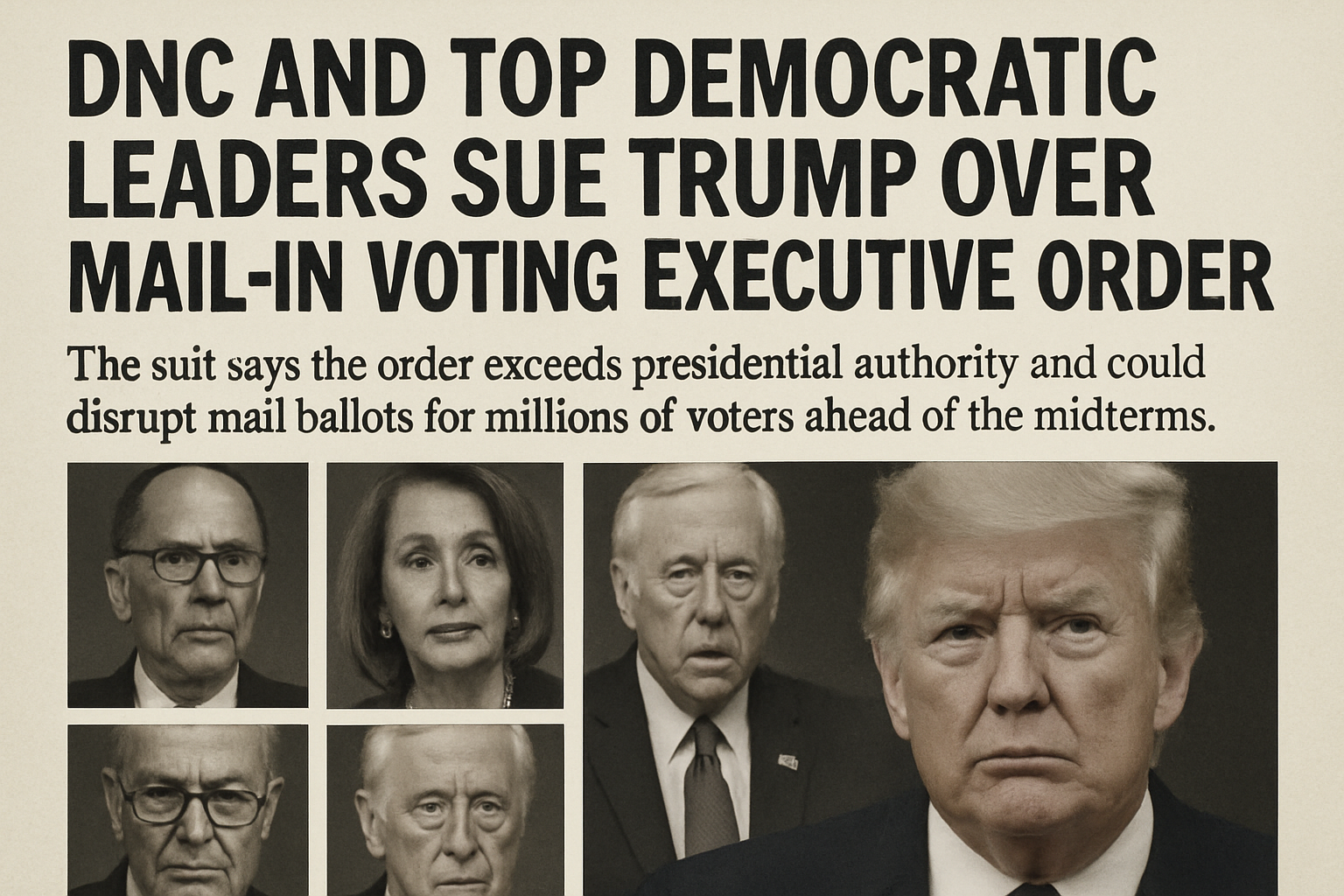
In a stunning twist of events, the Democratic National Committee (DNC), along with a robust contingent of Democratic leaders, has mounted a legal challenge against President Donald Trump. The bone of contention is the recent executive order issued by the President regarding mail-in voting. The lawsuit is an objection to what the plaintiffs describe as the ‘overreach of presidential authority,’ specifically citing fears that the directive could potentially jeopardize the voting rights of millions of Americans, just as the crucial midterm elections are around the corner.
The President’s executive order, issued amid a heated national debate on the security and validity of mail-in voting, has incited a whirlwind of controversy. Supporters of the directive claim that it seeks to safeguard the integrity of the electoral process, while its critics brand it as a ploy aimed at suppressing voter turnout, with damaging implications for the functioning of the democracy at large.
The Democratic party argues that this order transgresses the bounds of presidential authority. It believes the order encroaches upon the powers and privileges accorded to individual states, subverting the delicate balance of America’s federal system. It further contends that this executive order defies the democratic principles enshrined in the Constitution.
The Democratic response is rooted in the conviction that the executive order constitutes an eminent threat to the conduct of fair and transparent elections. The Democrats assert that it could lead to significant disruptions in the mail-balloting process, potentially disenfranchising millions of voters. This concern arrives at a time when a substantial number of Americans intend to cast their votes through mail because of the ongoing pandemic. Many are fearful that if the executive order is allowed to stand, those who cannot vote in person – for reasons relating to health or otherwise – might be effectively robbed of their right to vote.
The challenge brought forth by the DNC and its top leadership is also influenced by the recent patterns of mail-in voting. Historically, Democrats have shown a greater tendency to vote by mail compared to their Republican counterparts. As such, any disruptions in the mail-balloting process could disproportionately affect the Democratic electorate, skewing the results of the elections in favor of the GOP.
The suit offers a stern reflection of what Democrats view as a serious and impending threat to the principles of American democracy. Amid claims and counterclaims, fears, and apprehensions, it emphasizes the critical nature of the upcoming midterm elections. It seeks to ensure that every eligible voter can exercise their democratic rights without let or hindrance.
Beyond the issue of mail-in voting, the ongoing suit underscores the tension and conflict characterizing the political landscape of the United States. It provides an insight into the broader debate over executive powers, probing the limits of presidential authority in shaping the mechanics of the electoral process. Moreover, it highlights the challenges faced by the electoral system amidst a global pandemic, with implications that extend far beyond the upcoming midterms.
As the lawsuit continues and the midterm elections draw closer, the attention of the nation is focused on the struggle between the White House and its critics. While the final verdict on this case remains to be seen, its wider consequences for the American political landscape are likely to be far-reaching and profound.
Title: “An Unconventional Approach: Trump’s Stand Against Political Malpractice”
Imagine a high-stakes poker game where one player repeatedly makes unlawful moves but is somehow allowed to keep playing. Frustrations and accusations ensue, eventually culminating in the inevitable disruption of the game altogether. This scenario closely aligns with Donald Trump’s continuous assertion, “They won’t let us cheat.” The audacity of this unconventional assertion in the grounds of political panorama further exemplifies Donald Trump’s unique leadership style, associating significant implications for American democratic processes.
Transparent Election Process
One of the distinguishing aspects of modern democracy is the transparency of the electoral process. But like the poker game, the scenario becomes distorted when there are allegations or instances of cheating. In condemning such actions, Trump amplifies his commitment to ensuring an egalitarian and transparent political structure. His assertiveness portrays his stand against political ill-practices, as he voices his staunch opposition to any form of unfair play.
Pursuit for Electoral Integrity
Trump’s critics argue that his often controversial and headline-grabbing comments are driven by self-interest. Yet, his continual assertion that ‘they won’t let us cheat’ can also be interpreted as a determination to uphold electoral integrity. The former president appears to endorse a fair and square political battle, which is instrumental in promoting a democratic ethos of equals, rather than weaker parties being exploited by political malpractice.
No ‘Business as Usual’ Politics
Trump’s approach to politics could be perceived as an ostensible disconnection from the established norms since he has exhibited a formidable stand against ‘business as usual’ politics. His unwillingness to conform to the conventional mould has been a point of contentions, yet it also exposed vulnerabilities within the existing political system. ‘They won’t let us cheat’ underscores this sentiment, pushing for changes in a system that may require robust revision and regulation.
The ‘Trump’ Effect
The ‘Trump’ effect, showcasing unconventional political assertiveness, is an inherent part of his political strategy. ‘They won’t let us cheat’ is one such dialogue that incites discussion and debate about the current state of American politics. His statements, although controversial, sparks conversations about the transparency and integrity of democratic systems, leaving an indelible imprint on the canvas of American politics.
Conclusion
Regardless of individual opinions about Donald Trump, his assertive stance against cheating in politics acts as a disruptive force in the political arena. It opens up dialogues surrounding transparency, electoral integrity, and political malpractice. His robust approach towards ‘clean’ politics, as contested as it may be, has undeniably stipulated a new discourse in the American political sphere. Consequently, future leaders may be increasingly held accountable for upholding ethical standards, democratizing the political battlefield, and ensuring the sanctity of a transparent electoral process.
Discover more from -
Subscribe to get the latest posts sent to your email.