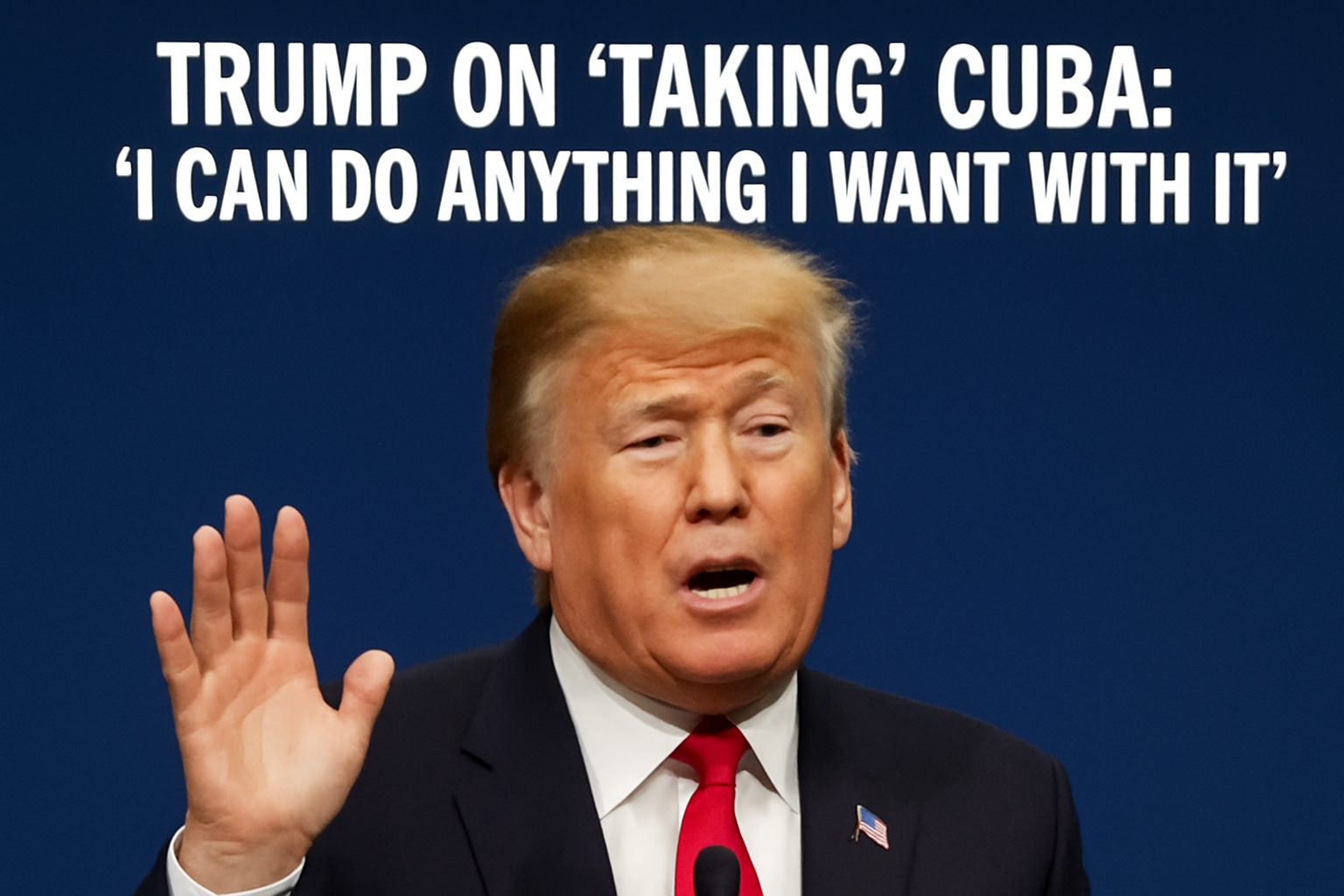
As the week started off, President Donald Trump made a startling announcement that caught many by surprise. During a press conference on Monday, he spoke confidently about his expectations to have the “honor” of “taking Cuba”, hinting at potential future actions towards the island nation.
This statement came just days after Cuba openly acknowledged engaging in talks with the United States, suggesting a potential shift in the long-standing relationship between the two countries. However, the situation quickly took a turn as Cuba’s Ministry of Energy and Mines reported a complete disconnection of the national grid, leading to a widespread blackout across the country.
The effects of this blackout were felt not just in terms of power outages, but also through significant drops in internet traffic. The monitoring organizations NetBlocks and Kentik recorded sharp decreases in online activity, indicating a disruption in communication and access to information for Cuban citizens.
Reports from insiders revealed that U.S. officials involved in the talks with Cuba were pushing for political concessions, including the ousting of President Miguel Díaz‑Canel. Additionally, there were efforts to block foreign oil imports to the country, which led to fuel shortages and subsequent price hikes. The situation became so dire that hospitals were forced to cut back on services, schools had to reduce hours, and transportation services were scaled back.
The impact of these measures was further exacerbated by the decision of major airlines such as American Airlines, Delta, JetBlue, and Air Canada to halt flights to Cuba, further isolating the country. As tensions continued to rise, President Trump hinted at military options, raising concerns about a potential conflict reminiscent of past interventions in countries like Venezuela and Iran.
On the other side, Cuban Deputy Foreign Minister Carlos Fernández de Cossío expressed a sense of cynicism, suggesting that some officials may have been celebrating the hardships faced by Cuban families as a result of the blackout. This callous response only added fuel to the fire, highlighting the deep-rooted animosity and mistrust between the two nations.
Overall, the events of this week have highlighted the fragile nature of the relationship between the United States and Cuba, raising concerns about the potential for further escalation and the impact it could have on the Cuban people. As the situation continues to unfold, it remains to be seen how both countries will navigate this challenging and volatile landscape.
Analysis of President Trump’s Statement on Cuba
Recent remarks by former President Donald Trump garnered attention, particularly his assertion that he possesses the authority to action regarding Cuba. He stated,I can do anything I want with it,” implying a level of control and over the Caribbean nation that has historically been subject to complex diplomatic relations.
Such declarations raise questions about scope of executive and the potential for unilateral actions in foreign policy. While statement appears to be rhetorical, it underscores the ongoing tensions the possibility of renewed efforts to exert pressure on Cuba through various means.
The context surrounding this remark suggests a strategic aimed at asserting dominance or readiness for decisive measures. It is essential to interpret these comments within the broader framework of U.S.-Cuba relations, which have experienced fluctuations between engagement and over recent decades.
In terms, statements of this nature can serve as a warning or a demonstration of resolve, but they also carry risks of escalation and misinterpretation. Policymakers and alike must consider the legal, geopolitical and implications before any steps are undertaken based on assertions.
Ultimately, while President Trump’s declaration emphasizes strong stance, the actual capacity to “do anything” remains constrained international law, protocols, and the complex of relations The situation warrants close monitoring as developments in this sensitive regional context.
Discover more from -
Subscribe to get the latest posts sent to your email.