
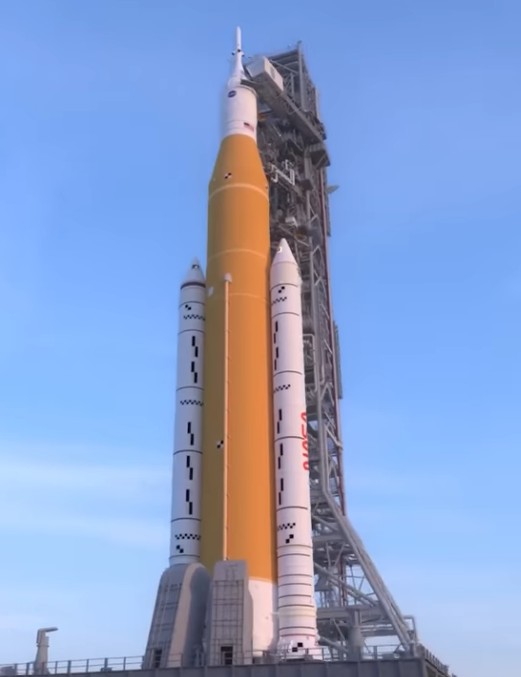
<!-- wp:social-links --><ul class="wp-block-social-links"><!-- wp:social-link {"url":"https://gravatar.com/trendquest2014","service":"gravatar","rel":"me"} /--></ul><!-- /wp:social-links -->Imagine being in a race where one competitor is driving a modern, state-of-the-art sports car, while the other is stuck behind the wheel of a decades-old clunker. This is the comparison that can be made between SpaceX’s Starship and NASA’s outdated moon rocket, the Space Launch System (SLS).
In recent years, SpaceX has taken the lead in the space industry with its innovative spacecraft designs and ambitious goals. The Starship, in particular, has garnered attention for its potential to revolutionize space travel and exploration. Meanwhile, NASA’s SLS has faced numerous delays and budget overruns, leading many to question its relevance in an increasingly competitive space race.
One key reason why SpaceX’s Starship could outshine NASA’s SLS is its cost-effectiveness. SpaceX has made a name for itself by developing reusable rockets that drastically reduce the cost of space missions. In contrast, the SLS is a one-time use rocket that comes with a hefty price tag. With budget constraints becoming an increasingly important factor in space exploration, SpaceX’s cost-effective approach could give it a significant advantage over NASA.
Another advantage of the Starship is its versatility. SpaceX envisions the Starship as a multipurpose spacecraft that can be used for a wide range of missions, from taking astronauts to the Moon and Mars to launching satellites into orbit. In comparison, the SLS is primarily designed for launching crewed missions to the Moon, limiting its potential applications. The flexibility of the Starship could make it a more attractive option for future space missions.
Furthermore, SpaceX has a track record of innovation and rapid development that could give it an edge over NASA. The company has made significant advancements in rocket technology in a relatively short amount of time, while NASA has struggled with delays and setbacks in developing the SLS. SpaceX’s ability to quickly iterate on design changes and test new technologies could enable it to stay ahead of the competition in the space industry.
In conclusion, while NASA has a long history of space exploration and scientific achievements, it is clear that SpaceX’s Starship has the potential to outshine NASA’s outdated moon rocket, the SLS. With its cost-effectiveness, versatility, and innovative approach to space travel, the Starship could usher in a new era of space exploration and establish SpaceX as a dominant player in the industry. NASA may need to adapt and evolve in order to keep pace with the rapidly changing landscape of space exploration.
In a world where space exploration is becoming increasingly competitive, NASA finds itself in a precarious position. The space agency’s ambitious plans to return to the moon with its $23.8 billion Space Launch System (SLS) have hit a major roadblock – the rocket is completely outdated and unable to beat China in the race to space.
Imagine this scenario: NASA engineers work tirelessly to prepare the SLS for its maiden flight, only to be overshadowed by China’s rapid advancements in space technology. The once mighty agency now finds itself struggling to keep up with the pace of innovation set by its global competitors.
The SLS, originally designed in the early 2000s, was meant to be the most powerful rocket ever built by NASA. However, delays and cost overruns have plagued the project, leaving the agency with a rocket that is unable to compete with China’s heavy-lift Long March rockets.
One of the key drawbacks of the SLS is its reliance on outdated technology and manufacturing processes. While China has been able to rapidly develop and test new rocket designs, NASA has been bogged down by bureaucracy and red tape, hindering its ability to keep up with the competition.
Enter SpaceX and its revolutionary Starship rocket. Elon Musk’s space company has been making waves in the aerospace industry with its ambitious plans for Mars colonization and lunar exploration. The Starship, with its fully reusable design and cutting-edge technology, has the potential to revolutionize space travel and make the SLS obsolete.
With SpaceX set to launch its first manned mission to the moon in the coming years, NASA must now face the reality that its once groundbreaking rocket is no longer fit for purpose. The agency must adapt and embrace new technologies if it hopes to remain competitive in the new space race.
In conclusion, NASA’s $23.8 billion SLS rocket is a relic of the past, unable to keep pace with the rapid advancements in space technology. With China and SpaceX leading the charge towards the future of space exploration, NASA must reassess its priorities and invest in cutting-edge technology if it hopes to remain relevant in the ever-changing landscape of space travel.
Discover more from -
Subscribe to get the latest posts sent to your email.