









Executive Summary
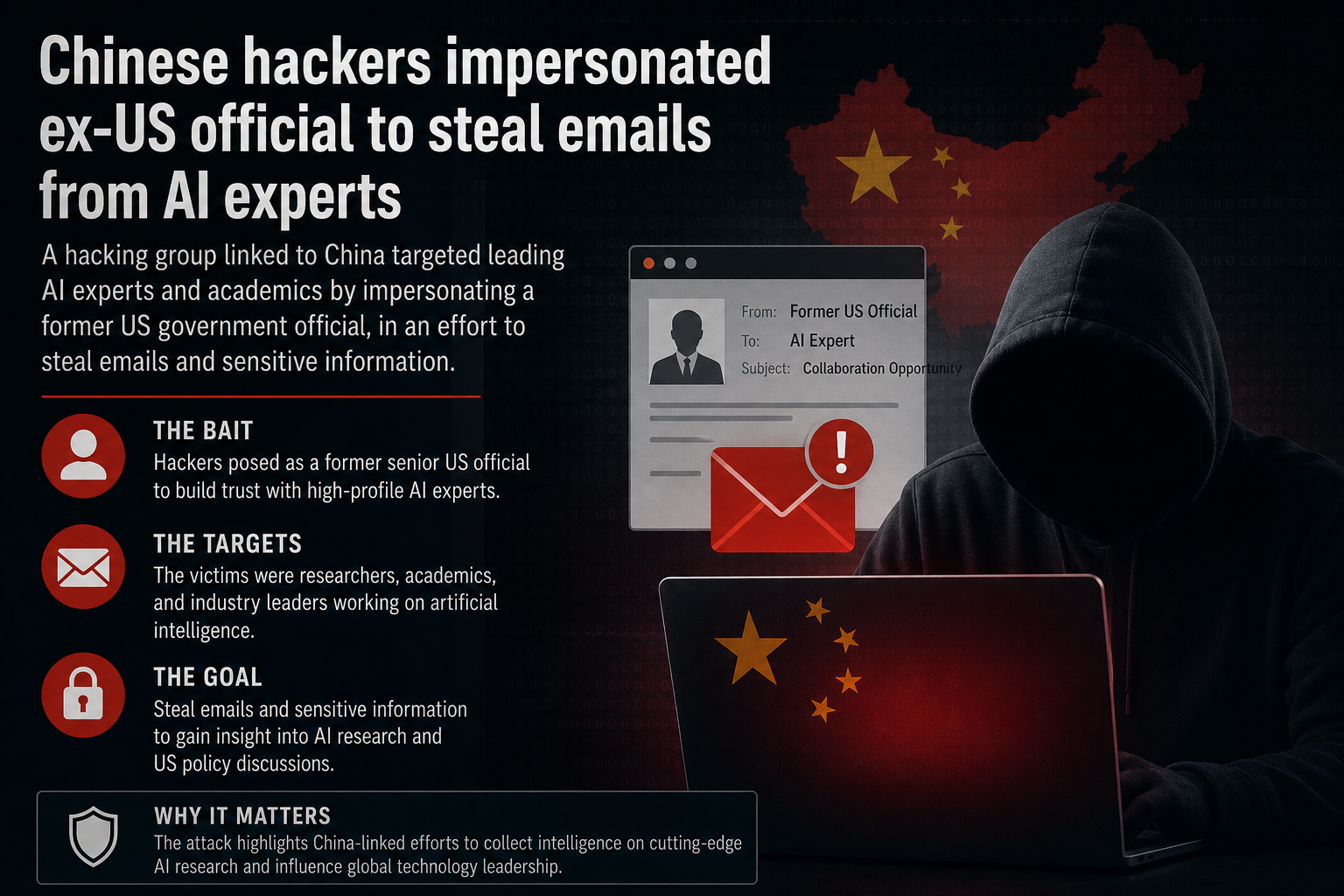
Chinese hackers impersonated ex-US official to steal emails from AI experts.
Moreover, they used social engineering, targeted spear-phishing campaigns, and compromised credentials to access sensitive communications.
No public reports confirm that critical infrastructure was exposed or that proprietary AI models were disclosed as a direct result.
Incident Overview
- Perpetrators: State-aligned cyber threat actors with a history of credential harvesting and political or strategic influence operations.
- Method: Impersonation of a high-profile former US official to establish legitimacy in communications; use of targeted phishing emails and credential harvesting techniques.
- Target pool: AI researchers, industry experts, and associated think tanks or private-sector teams with access to sensitive research discussions.
- Objective: Access to confidential communications, early insight into research developments, and potential dissemination of stolen information.
Attack Vector and Tactics
- Social engineering: Crafting believable narratives around the impersonated identity to prompt trust and cooperation.
- Credential access: Phishing messages designed to harvest usernames, passwords, or multi-factor authentication codes.
- Lateral movement: Exploitation of compromised accounts to access connected email threads and archived conversations.
- Data exfiltration: Extraction of email content, calendar invites, and attachments relevant to ongoing AI research.
Impact Assessment
- Short-term: Potential exposure of private discussions, collaboration plans, and pre-publication research outlines.
- Medium-term: Increased risk of targeted phishing for collaborators and partners; erosion of trust in official communications channels.
- Long-term: Possible chilling effect on collaboration within the AI research community if actors successfully misrepresent affiliations.
Indicators of Compromise
- Unusual login patterns from unfamiliar IP ranges or devices.
- Email threads showing suspicious or unexpected requests from the impersonated contact.
- Abnormal authentication prompts or MFA codes requested outside typical workflows.
- New or altered contact information within trusted correspondence networks.
Mitigation and Response Recommendations
- Verify identity through independent channels before sharing sensitive information or granting access.
- Reinforce email security: enable MFA, review delegated access, and implement strict access controls for sensitive inboxes.
- Conduct phishing awareness training tailored to spear-phishing and identity impersonation techniques.
- Implement domain-based message authentication, reporting, and conformance (DMARC) policies to reduce spoofing.
- Audit and monitor for unusual cross-organization communications and data flows related to AI research discussions.
- Establish rapid incident response playbooks for suspected impersonation and credential compromise.
Best Practices for Researchers and Organizations
- Maintain separate, verifiable contact channels for official communications and collaboration requests.
- Limit exposure of pre-publication research details to registered collaborators with verified identities.
- Use encrypted communications for sensitive information and implement least-privilege access for email accounts.
- Regularly rotate credentials and review third-party access to repositories and collaboration platforms.
- Share incident indicators with a centralized security team and relevant partner organizations for rapid containment.
Public Communication Guidance
- Provide a clear, concise statement outlining the incident, suspected methods, and steps taken to mitigate risks.
- Offer guidance for collaborators to verify communications and report suspicious activity.
- Maintain transparency about remediation efforts without disclosing sensitive operational details.
Conclusion
The incident underscores the persistent risk of identity-based social engineering in targeted cyber espionage.
Moreover, vigilance and verification are essential for safeguarding communications within AI researchers and allied organizations.
Chinese hackers impersonated an ex-US official to steal emails from AI experts.
References
- National cybersecurity advisories on credential harvesting and impersonation.
- Industry reports on spear-phishing campaigns targeting technology researchers.
- Best-practice guides for email security, MFA deployment, and incident response.

