














Analysis
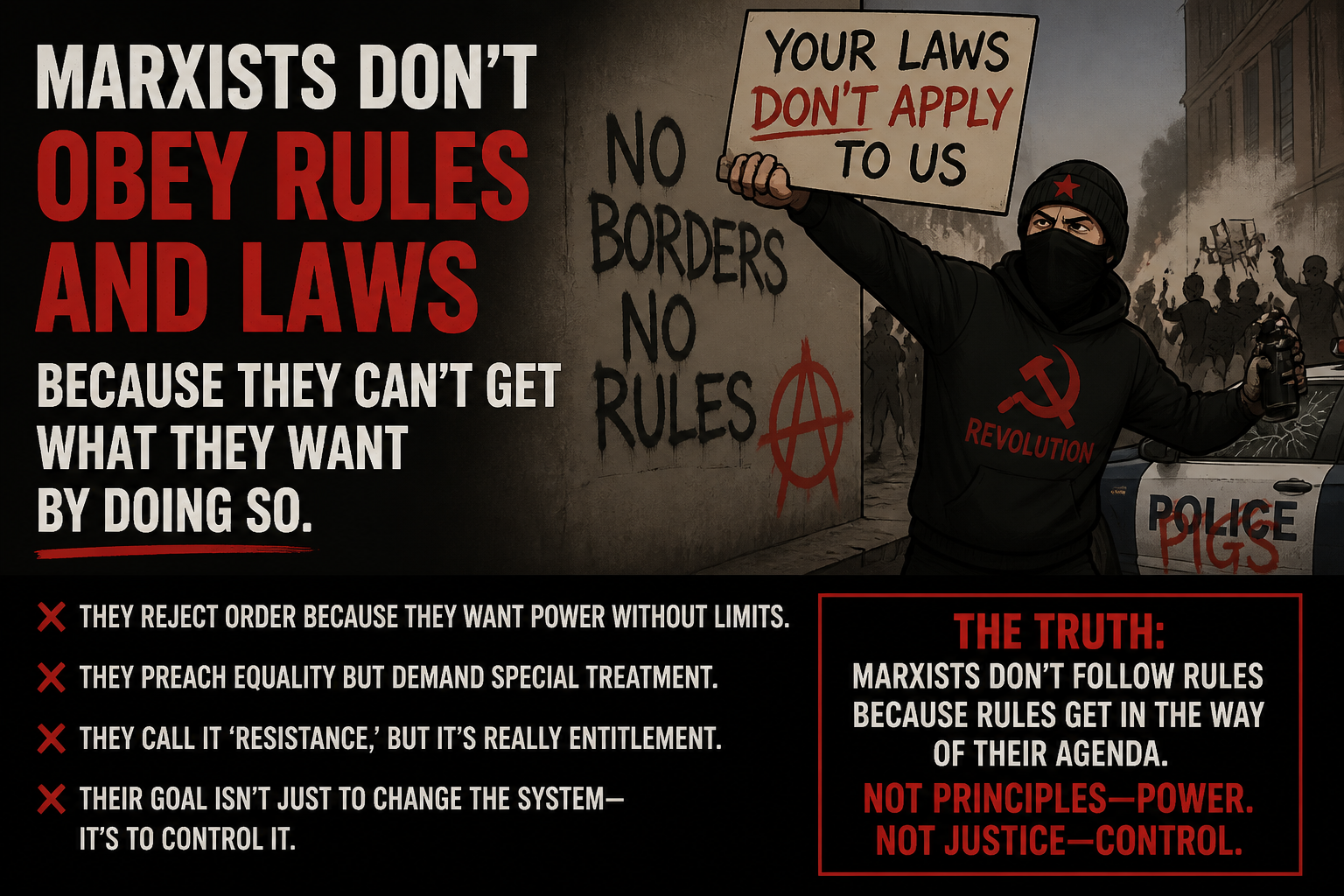
The statement reflects a sweeping generalization about Marxists, attributing a disregard for rules and laws to an inability to attain goals through lawful means. A careful assessment reveals several points worth considering.
Context and scope
- Marxism is a broad political and intellectual tradition encompassing a range of theories, schools, and practices. While some movements inspired by Marxist ideas have engaged in unlawful actions, many Marxists explicitly advocate lawful political participation, constitutional methods, and democratic processes.
- The assertion conflates tactics with ideology. Adherence to or defiance of laws is often shaped by strategic considerations, historical context, and perceived legitimacy of the governing framework rather than a universal property of a given ideology.
Historical patterns
- Throughout history, factions influenced by Marxist thought have operated within both legal and illegal channels. In some periods, revolutionary movements rejected existing legal orders as illegitimate or oppressive, arguing that the legal framework itself required transformation. In other eras, Marxist groups pursued reforms through parliamentary means, labor organizing, education, and social programs within the bounds of law.
- It is important to distinguish between outright illegality, civil disobedience, and participation in formal institutions. Civil disobedience has been a feature of various reform movements worldwide, not unique to Marxist currents.
Analytical considerations
- The claim risks oversimplifying complex phenomena by associating tactics with an entire ideological lineage. Individual actors’ choices are influenced by leadership, strategy, repression by authorities, and social conditions, among other factors.
- A nuanced perspective recognizes that any political tradition can spawn both lawful and unlawful actions depending on circumstances, goals, and perceived legitimacy of existing institutions.
Counterpoints
- Many contemporary socialist and Marxist-influenced groups operate through established political parties, unions, think tanks, and community organizations that prioritize nonviolent, legal methods.
- Critiques of capitalist systems by Marxist thinkers often focus on structural analysis and propose reforms aimed at expanding legal protections, access to resources, and democratic control.
Conclusion
The claim that Marxists don’t obey rules and laws is an overgeneralization. While certain movements associated with Marxist ideas have engaged in illegal action at times, many adherents advocate and practice lawful political engagement. A rigorous evaluation requires examining specific groups, historical periods, and the strategic rationales behind their methods rather than attributing a monolithic stance to an entire ideological tradition. Marxists don’t obey rules and laws because they can’t get what they want by doing so…. (focus keyphrase)
