









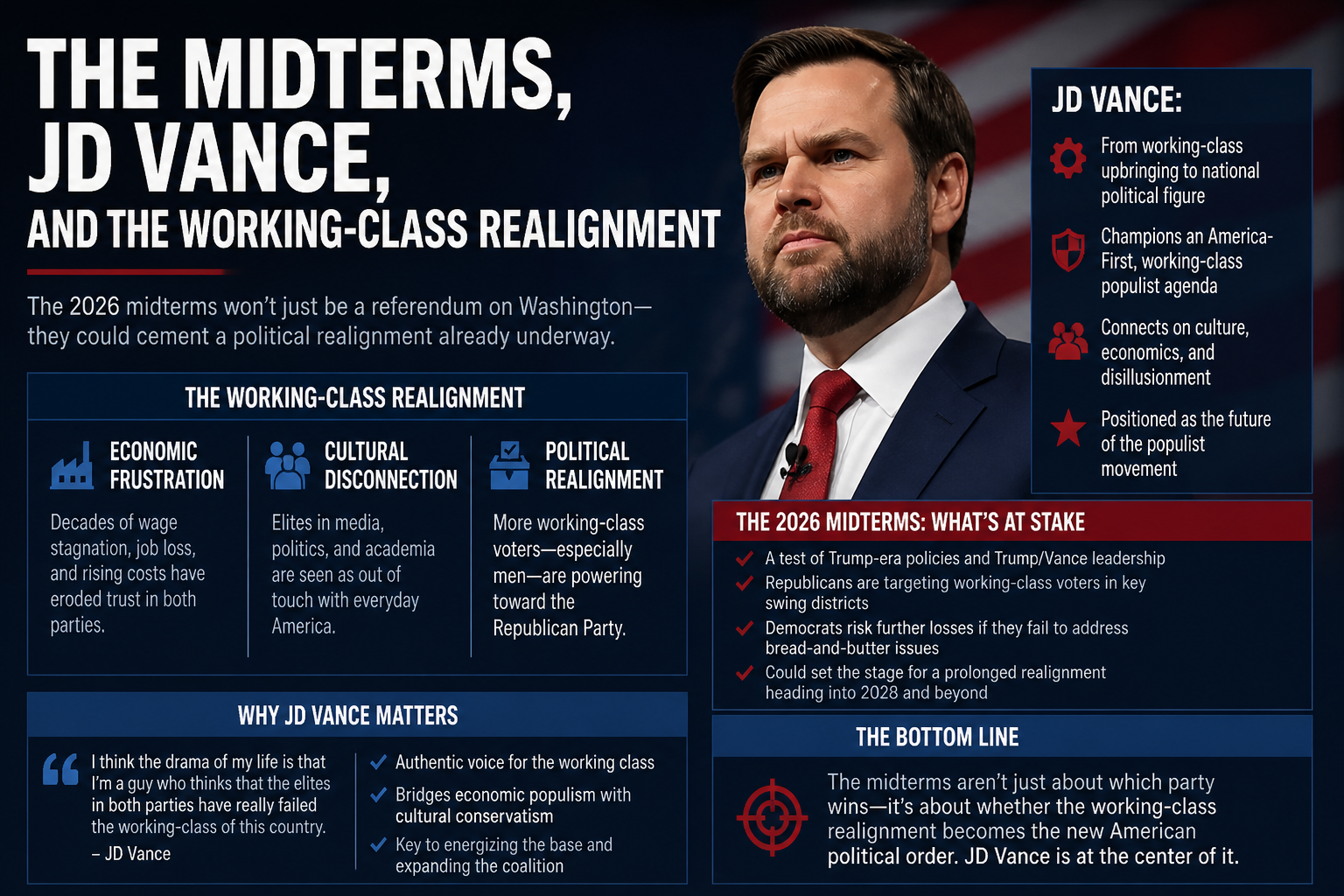
Overview
Firstly, the recent midterm cycle foregrounds how working-class voters re-calibrate loyalties amid economic pressures. This analysis considers The Midterms, JD Vance, and the Working-Class Realignment as a focal lens. Moreover, public debate centers on whether economic populism and media narratives can sustain broad support.
Secondly, the piece surveys the role of JD Vance in shaping regional discussions and policy talk. Furthermore, it examines whether these dynamics signal a broader realignment among blue-collar constituencies. Finally, the analysis considers potential political consequences if the trend persists.
Context: economic and social currents shaping the electorate
Several forces shape voting behavior among working-class populations in recent years. Wage stagnation and rising costs of essentials contribute to this influence. Persistent regional economic restructuring also shapes how people view policy offerings. These shifts leave many voters frustrated with traditional party alignments.
Meanwhile, concerns about crime, immigration, and cultural belonging energize both sides, creating a complex mosaic of loyalties beyond simple labels. As a result, loyalties defy easy partisan categorization. Voters weigh safety, values, and economic prospects together. This mosaic resists simple partisan labeling.
Policy debates surrounding taxation, healthcare, energy, and manufacturing have assumed greater salience for working-class voters. They seek tangible improvements in everyday life. In several districts, candidate performance depended more on perceived competence and credibility. Moreover, they valued responsiveness to local economic realities over ideological purity.
The midterms tested whether economic anxieties could translate into durable realignments. Consequently, traditional partisan loyalties would prevail amid short-term volatility. The outcome depended on voters’ experiences at the local level. Voters assessed what change would mean for their jobs, wages, and communities. Politicians responded with proposals aimed at steady, tangible improvements.
JD Vance: profile, appeal, and electoral performance
The Midterms, JD Vance, and the Working-Class Realignment helped frame his rise to national prominence. It came through a blend of memoir, media visibility, and political organizing. The narrative combined personal history with broader political signals. Observers noted how that framing linked identity with policy.
Supporters saw a path from factories to families. They argued the approach would restore confidence and opportunity. Critics warned about risk to broader coalitions. Yet the core messages emphasized tangible gains for workers. The public debate also tested beliefs about work and belonging. In response, campaign rhetoric framed economic hope as achievable.
Supporters repeatedly tied aspiration to community bonds. They framed policy proposals as practical steps. That linkage underpinned a broader realignment. Observers noted continued relevance among working-class voters. The narrative endured across election cycles. Its appeal lay in concrete, attainable goals. Therefore, supporters linked identity with economic reform.
From an electoral perspective, Vance’s success has been attributed to several factors. First, his ability to connect with voters who express concern about job security and economic fairness, while also appealing to those who prioritize cultural issues, has broadened his reach beyond core conservative constituencies. Second, strategic campaigning—emphasizing local grievances, endorsements from business and civic leaders, and targeted messaging—helped translate broad themes into district-level resonance. Third, the broader national mood, including the public’s perception of incumbents and party performance, influenced the electoral calculus of many voters who sought a break from the status quo.
However, the reception of Vance’s approach has been uneven across the political spectrum. Moreover, critics say the emphasis on cultural grievances risks alienating educated professionals and suburban voters.
Additionally, a message centered on nostalgia or single-issue concerns may fail to address economic change. The midterm results thus provide a data-rich snapshot of where Vance’s messaging is persuasive and where it loses traction.
The midterms: outcomes and what they suggest about realignment
The midterm results offered a mixed picture of working-class realignment dynamics. For example, in some districts, candidates who foregrounded economic populism and job-creation rhetoric performed well. This signaled continued appetite for policy directions that promise tangible improvements in local economies.
Meanwhile, in other areas, voters demonstrated careful calibration. They rewarded competence and pragmatic governance over sweeping ideological change. Additionally, voters weighed local results over national rhetoric. As a result, the alignment appears nuanced rather than uniform. Ultimately, voters sought steady governance and steady improvements.
Several patterns emerged:
- Local economic framing mattered: Candidates who tied policy proposals to concrete opportunities—such as manufacturing incentives, infrastructure investment, and workforce development—gained credibility with swing voters who prioritize steady improvements in living standards.
- The trade-off between culture and economics: In multiple contests, voters balanced cultural concerns with economic imperatives. Teams that offered a synthesis—protecting social cohesion while advancing practical economic programs—often fared better than those anchored exclusively in either domain.
- Message discipline and authenticity: Voters responded to messages that appeared grounded in lived experience and community knowledge. Authenticity, demonstrated through consistent policy positions and visible engagement with local issues, often outweighed grand, national grandstanding.
- The role of incumbency and local institutions: Local endorsements, business associations, and civic organizations significantly influenced outcomes. The perception that a candidate would reliably represent regional interests often trumped broader ideological labels.
Taken together, the results suggest that while a working-class realignment remains a real possibility, its durability depends on a sustained alignment of policy prescriptions with the material needs of ordinary people, rather than on rhetorical appeal alone. The trajectory will likely hinge on whether parties can deliver targeted economic upgrades and maintain trust through governance that demonstrates results.
Drivers of working-class realignment: what matters most
Several core drivers appear to shape the potential realignment:
- Economic security and mobility: Access to stable employment, rising wages, and opportunities for skill development are central concerns. Programs that reduce barriers to entry for middle- and low-skill workers—such as apprenticeships, retraining, and regional investment—tend to resonate.
- Job quality and regional investment: The presence of well-paying, durable jobs in local industries, coupled with reliable infrastructure and public services, strengthens political confidence in governing parties or coalitions that deliver tangible improvements.
- Healthcare and retirement security: The affordability and reliability of healthcare, along with pension and retirement protections, remain high priorities for working families navigating uncertainty.
- Trust and governance: Voters increasingly distinguish between broad policy preferences and the perceived honesty, competence, and accountability of elected officials. Transparent governance and accountable policy implementation matter as much as the policy content itself.
- Cultural and community considerations: Attitudes toward crime, family stability, and social norms influence political choices, particularly in regions where social cohesion and local identity play a significant role.
Implications for policy and political strategy
For policymakers and political strategists, several implications emerge:
- Prioritize tangible, localized policy wins: Proposals that can be implemented with clear timelines and measurable outcomes—such as targeted industrial investment, workforce ups killing, and regional infrastructure projects—are more persuasive to working-class voters than broad ideological proclamations.
- Combine economic realism with credible cultural sensitivities: A successful approach blends empathy for community concerns with practical plans that improve daily life, avoiding adversarial or exclusionary rhetoric.
- Strengthen accountability mechanisms: Voters respond to evidence of progress. Regular reporting on program impacts, independent audits, and stakeholder consultation can bolster legitimacy and trust.
- Invest in long-term regional capacity: Building sustainable economic ecosystems requires ongoing support for education, research, and public-private partnerships that align with regional strengths and demand.
Conclusion
The interplay among The Midterms, JD Vance, and the Working-Class Realignment highlights a political landscape. Indeed, it prizes pragmatism as much as principle. This dynamic shapes how voters evaluate candidates and policy proposals. Across regions, communities seek results over rhetoric and steady governance.
As districts continue to grapple with economic transition, parties that translate rhetoric into results gain durable support. Moreover, credible governance and a sustained focus on working families matter across diverse regions. This accountability loop helps secure long-term backing in the face of shifting economic currents.