











Overview
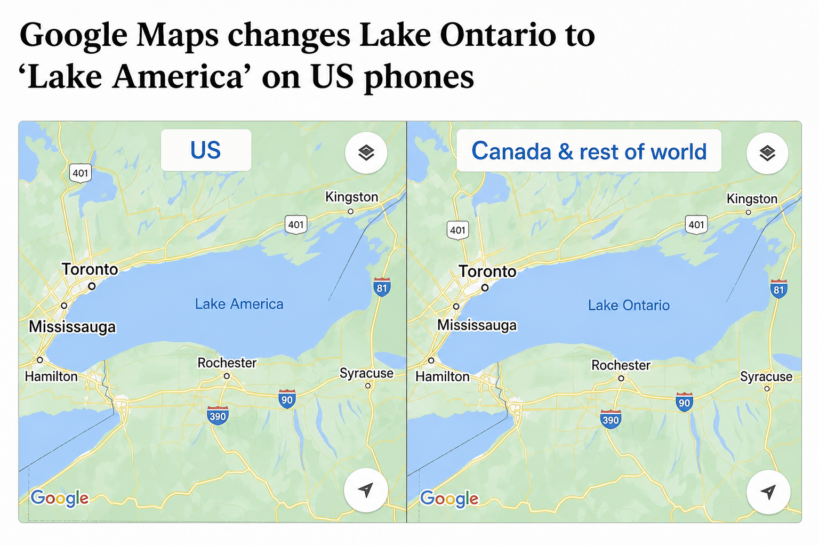
Recent reports indicate that Google Maps on United States devices is displaying Lake Ontario under the name “Lake America.” The naming change appears in certain locales and device configurations, prompting questions about its origin, scope, and potential impact on users and navigation workflows.
What happened
Users in parts of the United States observed the geographic label for Lake Ontario shifting from the conventional designation to “Lake America” within Google Maps. The behavior was noted across various map views and search results, with the body of water itself remaining in place on the map. The incident has drawn attention from local residents, travelers, and information-watchers who rely on map labels for orientation and travel planning.
Possible explanations
- Data labeling updates: Google Maps data sources may undergo periodic revisions to reflect perceived historical, cultural, or regional naming conventions. An update could introduce a new label in some regions before a broader rollout.
- Regional testing: Tech platforms frequently test new features or labels with subsets of users. A/B testing could explain why only certain devices or locations show the altered name.
- Data conflicts or geocoding anomalies: Inconsistent or conflicting data from map sources can yield unusual label results in specific areas or devices.
- Temporary glitch or cache issue: Local device caches or rendering quirks can momentarily display alternate names without reflecting a permanent change.
Implications for users
- Navigation and memory recall: Some users accustomed to the traditional name might experience brief confusion when reorienting to the new label.
- Local context and diplomacy: Altered naming can intersect with regional identity or sensitivities; monitoring how such changes are received can inform future labeling decisions.
- Data consistency: Recurrent or widespread label changes can affect search accuracy, saved routes, and sharing of location information.
What users can do
- Verify across devices: Check Lake Ontario’s label on multiple devices or platforms (e.g., mobile app vs. desktop) to determine if the change is device-specific.
- Clear caches if needed: If unexpected labels persist, clearing app or browser caches can help ensure you see the latest, intended data.
- Report inconsistencies: Use the map app’s feedback or report-a-issue feature to flag labeling discrepancies for review by Google’s data team.
- Monitor official channels: Stay informed through Google Maps support pages and official announcements, as widespread label updates are typically communicated by the provider.
Perspective and next steps
Label changes on widely used mapping services reflect ongoing efforts to refine geospatial data, cultural considerations, and localization strategies. Users should remain attentive to any subsequent updates from Google Maps, which may confirm, revert, or further modify the Lake Ontario designation. Continued observation will clarify whether this is a targeted test, a broader rollout, or a transient anomaly.
