













Overview
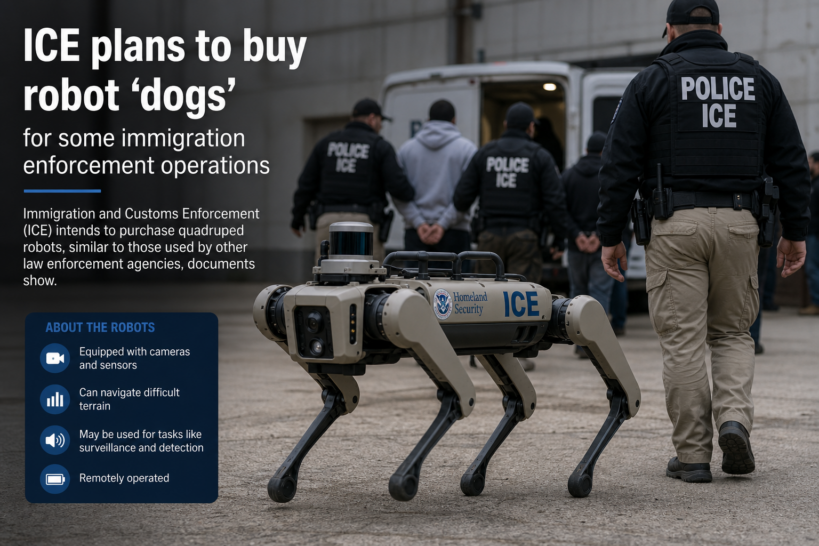
The deployment of robotic dogs by law enforcement agencies has drawn attention to the evolving role of autonomous technology in border and immigration operations. This article examines the motivation, potential applications, safeguards, and public concerns surrounding such acquisitions.
Background and context
Autonomous or remotely controlled legged robots are designed to navigate varied terrain and operate in environments that may pose risks to human officers. In immigration enforcement contexts, agencies may consider robotic assistance for surveillance, reconnaissance, or incident response. Proponents argue that robotic assets can reduce exposure to harm, enhance situational awareness, and support rapid decision-making. Critics raise questions about civil liberties, operator oversight, mission expansion, and the potential chilling effect on communities.
Potential applications and capabilities
- Surveillance and reconnaissance: Robotic platforms can extend an officer’s field of view in dangerous or uncertain environments without exposing personnel to direct danger.
- Crowd management support: In controlled, low-risk scenarios, robotic assets may assist with monitoring crowd dynamics or delivering nonlethal equipment, depending on policy allowances.
- Incident response: Robots can access confined spaces, contraband areas, or other hazardous zones to gather information or deter escalation.
- Training and exercises: Robotic systems can be used in simulations to improve readiness and response protocols while minimizing risk to trainees.
Legal and policy considerations
- Compliance with constitutional rights and statutory limits: Any use of robotic dogs must align with lawful procedures, due process protections, and agency regulations.
- Rules of engagement and escalation criteria: Clear guidelines should define when robotic assets may be deployed, what they may monitor, and how operators should intervene.
- Privacy protections: Safeguards are essential to prevent excessive surveillance and to limit data collection to mission-relevant information.
- Accountability and transparency: Documentation of deployments, outcomes, and channeling concerns to oversight bodies help maintain public trust.
Ethical and civil liberties concerns
- Impact on communities: The presence of robotic enforcement tools can influence behavior and perceptions of policing, particularly in vulnerable populations.
- Risk of mission creep: Technology introduced for specific scenarios could gradually expand into broader enforcement activities.
- Technical reliability and bias: Dependence on automated systems necessitates robust testing, maintenance, and safeguards against malfunctions or misuse.
Oversight, safeguards, and alternatives
- Independent review and public comment: External assessments can illuminate risks and build community trust.
- Proportionality and necessity: Deployments should be justified by clear danger or mission requirements, with proportional responses.
- Training and human-in-the-loop controls: Retaining human decision-makers alongside robotic systems helps preserve judgment and accountability.
- Non-technical alternatives: Enhanced training, improved officer safety protocols, and community-based strategies may address certain operational needs without deploying robotic assets.
Operational considerations and best practices
- Scenario-based planning: Define specific, permissible use cases aligned with policy goals and legal constraints.
- Maintenance and reliability: Regular testing, lifecycle management, and safety certifications reduce the likelihood of failures.
- Data governance: Establish data retention, access controls, and purpose limitation to protect privacy.
- Stakeholder engagement: Involve communities, civil rights organizations, and oversight bodies in dialogue about deployment plans.
Conclusion
The prospect of employing robotic dogs in immigration enforcement operations raises a spectrum of practical, legal, and ethical questions. Careful consideration of safeguards, transparent oversight, and a clear alignment with constitutional and policy standards are essential to ensure that any such implementation serves legitimate public safety objectives without compromising civil rights or public trust.

